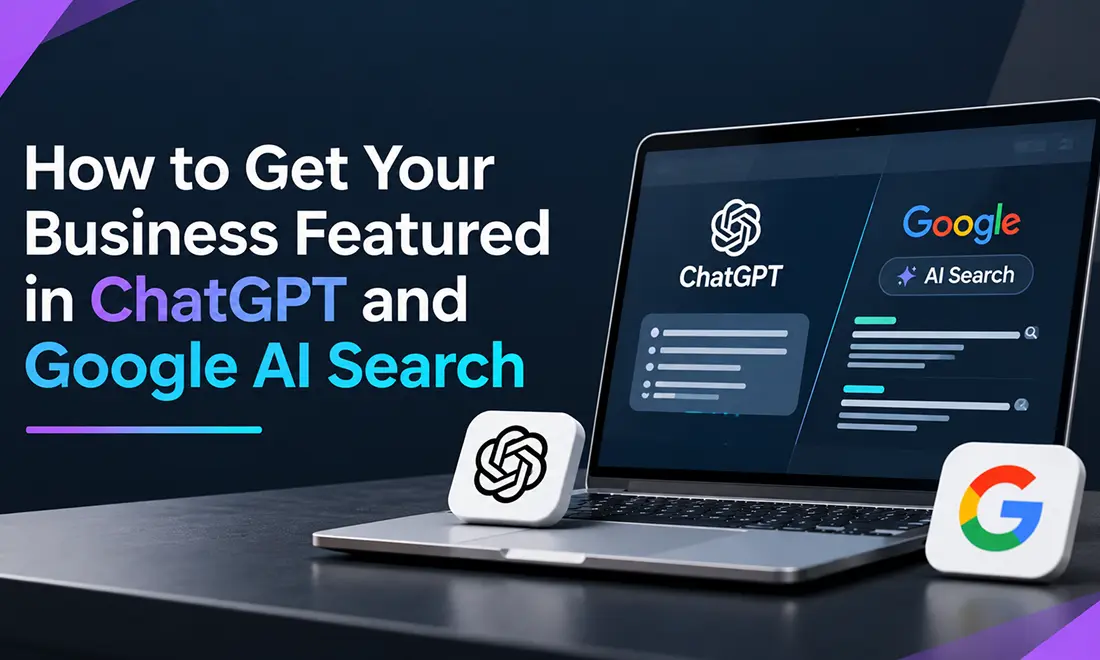
Someone looking for a service might once have searched Google, visited several websites, and compared their options. Now, they can ask ChatGPT to recommend a provider, use Google AI Overviews to understand their choices, or ask an AI search engine to compare businesses.
For business owners, this creates a new challenge: your website might appear in traditional search results without being mentioned in an AI-generated answer.
That is where AI search optimization becomes relevant. It involves making your website accessible, your information useful, and your expertise easier to understand and verify across AI-powered search experiences.
But getting found in AI search is not about adding a few questions to a page or inserting special keywords. It requires many of the same foundations that make a website valuable in traditional search, supported by accurate information, relevant content, and a credible online presence.
This guide explains how ChatGPT, Google’s AI search features, and other AI engines discover information, what businesses can improve, and how to assess whether those improvements are reaching potential customers.
How AI Search Decides Which Businesses and Websites to Surface
Traditional search engines generally present a list of results that users can explore. AI-powered search can go further by combining information from different sources into a response, sometimes including links to supporting websites.
That difference changes how people discover information, but it does not mean every AI platform uses the same process.
AI Search Relies on Relevance, Context, and Reliable Sources
Imagine someone asking ChatGPT:
“What should I look for when choosing an SEO agency for an ecommerce website?”
A useful response might explain technical SEO, product-page optimization, website migrations, reporting, and experience with ecommerce platforms.
A website that covers those subjects accurately could be relevant to the question. However, relevance alone does not guarantee that the website will appear as a source.
Search-enabled AI systems can retrieve information from websites and other available sources. The selection process varies by platform, query, and the information available at the time.
Google explains that AI Overviews and AI Mode can perform several related searches to gather supporting information for complex questions. Its systems may retrieve pages addressing different aspects of the original query.
This means businesses should think beyond matching individual keywords. Content needs to explain subjects clearly enough to answer the questions customers are actually asking.
A page that describes what a service includes, who needs it, and how it works may be more useful to readers than one that repeats the service keyword throughout.
Why Traditional SEO Still Matters for AI Visibility
One common misunderstanding is that businesses must abandon traditional SEO and adopt a completely separate approach to appear in AI search.
That is not what Google’s official guidance recommends.
Google states that its generative search features build upon existing Search systems and that established SEO best practices remain important.
These foundations include:
- Making important pages accessible to search crawlers.
- Publishing useful content that satisfies search intent.
- Maintaining a clear website structure and relevant internal links.
- Providing important information in readable text.
- Keeping pages technically sound and usable across devices.
- Making business details accurate and consistent.
For example, a technically inaccessible service page creates a discoverability problem before AI-specific considerations even enter the picture.
Similarly, a page containing little more than generic marketing claims gives potential customers limited information to evaluate.
That is why a strong SEO strategy remains a practical starting point for improving discoverability across traditional and AI-assisted search.
How AI Engines Use Sources, Citations, and Business Information
AI-generated answers do not always display sources in the same way.
ChatGPT Search can provide links to websites supporting its responses. Google’s AI Overviews and AI Mode can also display links that help users investigate a subject further.
Being mentioned in an AI response and receiving a clickable citation are not necessarily the same outcome.
Consider a business with a website describing its services, a detailed About page, published project examples, and consistent information across relevant professional platforms.
Those resources make it easier for people and potentially retrieval systems to understand what the company does and assess its credibility.
However, there is no universal formula that turns business profiles, backlinks, or schema markup into guaranteed AI recommendations.
The practical objective is to establish a clear and verifiable business presence while publishing information worth referencing.
How to Optimize Your Website for AI Search
Businesses do not need to rebuild their websites specifically for ChatGPT or Google AI Overviews. Most improvements begin with identifying what customers need to know and checking whether the website provides clear, accessible answers.
Create Content That Answers Real Customer Questions
People often use conversational language when interacting with AI search.
Instead of searching for “Shopify SEO agency,” someone might ask:
“What SEO problems should I fix before moving my online store from WooCommerce to Shopify?”
That question reveals a specific concern. A useful article could explain URL mapping, redirects, collection structures, product metadata, and post-migration monitoring.
Simply adding the question as a heading would not be enough. The page needs to provide a complete and reliable answer.
When improving website content, focus on:
- Answering the main question early: Give readers a useful explanation before expanding into details.
- Explaining the reasoning: Help users understand why a recommendation matters.
- Including practical examples: Show how the advice applies to real business situations.
- Supporting factual claims: Use trustworthy sources, especially for technical or changing topics.
- Keeping information readable: Use descriptive headings, concise paragraphs, and tables when they genuinely help.
For example, rather than writing “Technical SEO is essential for better website performance,” explain how incorrect canonical tags or blocked pages can affect discovery.
Specific information gives readers something they can use. It also makes the purpose of the content clearer.
Google’s guidance on generative AI search emphasizes original, valuable content rather than pages that simply repeat information already available elsewhere.
Build Topical Authority Around Your Business Expertise
Publishing many articles about unrelated subjects is not necessarily an effective content strategy.
A business benefits more from developing a connected body of content around the problems it can genuinely help solve.
Take a website development company as an example. Its content could cover website planning, platform selection, page speed, accessibility, technical SEO, and migration considerations.
Each article should answer a distinct question while linking naturally to related resources.
This creates opportunities for visitors to explore a subject in greater depth and helps search engines discover relevant pages.
The same approach applies to AI search topics.
A website might publish one comprehensive guide explaining AI search visibility, followed by narrower resources covering ChatGPT discoverability, Google AI Overviews, or measurement methods.
Related disciplines are often described using terms such as Generative Engine Optimization (GEO) and Answer Engine Optimization (AEO). These terms can help organize discussions about generative answers and answer-focused content, although they do not represent guaranteed ranking methods or entirely independent search systems.
The important distinction is search intent.
An educational article should explain a problem and provide practical guidance. A commercial service page should explain how a business delivers the relevant service.
Keeping those purposes separate helps create a useful content structure without making multiple pages compete for the same primary query.
Strengthen Crawlability, Internal Linking, and Structured Data
Even useful content can struggle to gain visibility when technical problems restrict access.
Start by checking whether search systems can reach important pages, interpret their content, and discover relevant information through the website’s navigation and internal links.
For ChatGPT Search, OpenAI identifies OAI-SearchBot as the crawler associated with search discovery. Website owners who want their content eligible for inclusion should avoid blocking that crawler and ensure their hosting or security systems permit its traffic.
OAI-SearchBot is distinct from GPTBot, which OpenAI uses for purposes related to training its foundation models. Their access controls can be managed separately.
For Google’s AI Overviews and AI Mode, a page generally needs to be indexed and eligible to appear in Search with a snippet to qualify as a supporting link.
Structured data can also help search engines interpret information such as business details, articles, products, and other supported content types.
However, Google explicitly states that there is no special AI schema required for its generative search features.
The same applies to publishing special AI-oriented text files or artificially splitting content into small sections. These are not requirements for appearing in Google’s AI results.
Instead of chasing technical shortcuts, prioritize a website that is accessible, clearly organized, and useful to visitors.
How to Build the Trust Signals AI Engines Look For
A website can be technically accessible and still provide little reason for someone to trust its information.
Businesses need to demonstrate that they understand their subject, have legitimate experience, and communicate accurate information.
This is where Google’s broader E-E-A-T framework Experience, Expertise, Authoritativeness, and Trustworthiness provides a useful way to evaluate content quality. It is not a separate numerical ranking score that website owners can directly optimize.
Demonstrate Experience Through Real Work and Original Insights
Consider two articles explaining how to migrate an ecommerce website.
The first offers familiar advice about choosing a platform, moving products, and checking the new store.
The second explains the actual problems businesses face: changing URL structures, preserving redirects, transferring product metadata, checking analytics, and verifying that the new store works correctly after launch.
The second article gives readers more practical information.
That kind of depth often comes from relevant professional experience.
At DIGIFLAI, our work across SEO, website development, and ecommerce projects has reinforced how closely content, technical structure, and user experience are connected. During a website migration, for example, transferring content is only one part of protecting search visibility. URL redirects, internal links, indexability, and tracking also need attention.
Businesses can bring similar experience into their own content through documented workflows, project examples, original screenshots, or explanations of decisions made during real work.
There is no need to manufacture statistics or present ordinary recommendations as exclusive research.
An accurate explanation of a problem you have genuinely encountered can be more valuable than an unsupported claim about impressive results.
Make Your Business Information Clear and Verifiable
Before trusting a business, customers usually want to know who is behind it, what services it provides, and whether its claims can be supported.
Your website should make that information easy to find.
Useful details include:
- A clear description of the company and its services.
- An About page explaining its background and expertise.
- Contact information and relevant business locations.
- Genuine testimonials or client references.
- Case studies supported by real project information.
- Author or reviewer details for specialist content.
These elements support transparency and user confidence. They may also help systems interpreting public web information understand your business more accurately.
For locally operating companies, maintaining an accurate Google Business Profile can be important for Google’s local search experiences.
Make sure the business name, location, opening hours, and services remain consistent across relevant platforms.
Avoid creating multiple inconsistent business descriptions simply to include more keywords.
A clear, accurate identity is more useful than a collection of profiles making contradictory claims.
Build Authority Beyond Your Own Website
A company can describe itself as an industry leader, but that statement means more when supported by credible information outside its website.
Relevant industry coverage, editorial mentions, professional directories, legitimate customer reviews, and references from other trusted websites can help strengthen a business’s wider presence.
For example, a specialist company contributing an expert explanation to a respected industry publication is providing something substantially different from submitting the same promotional description to dozens of unrelated websites.
Traditional link-building principles still apply: relevance and editorial quality matter more than acquiring large numbers of low-quality links.
Google also advises against pursuing inauthentic mentions as a shortcut to generative search visibility.
Think of external authority as a long-term outcome of useful work, credible expertise, and genuine relationships not a quota of citations to purchase.
How to Measure and Improve AI Search Visibility Over Time
AI search features do not always display identical answers. Results can differ depending on the platform, question, available sources, and changing search systems.
That makes measurement more complicated than checking one keyword position on Google.
Track Brand Mentions and Website Citations Across AI Engines
Start with a manageable collection of questions relevant to your business.
A website development company, for example, could monitor questions about choosing a development partner, comparing ecommerce platforms, or preparing for a website redesign.
Record whether the company appears, whether its website is cited, and which competing sources are referenced.
A simple tracking record might include:
| Metric | What to record |
| Search query | The exact question tested |
| AI platform | ChatGPT Search, Google AI Mode, etc. |
| Brand mention | Whether the company was named |
| Website citation | Whether a link to the website appeared |
| Cited page | The specific URL referenced |
| Date | When the result was checked |
Repeat the same tests periodically using a consistent method.
Remember that manual testing provides observations, not a complete measurement of how frequently a brand appears to every user.
Some AI engines can generate different responses to similar questions, so a single successful citation should not be treated as a permanent ranking.
Use Search Console and Analytics to Understand Performance
Traditional SEO data remains useful even as AI search features develop.
Google Search Console helps businesses evaluate search visibility and diagnose indexing issues. Google’s newer generative-AI reporting capabilities also provide additional insight into performance associated with its AI search experiences.
Google Analytics can help assess traffic and engagement after people reach the website.
OpenAI also documents referral tracking for links coming from ChatGPT Search, allowing website owners to investigate identifiable ChatGPT referrals in their analytics.
However, not every brand mention produces a click, and not every AI-assisted discovery can be attributed perfectly.
Review several indicators together:
- Organic search visibility and relevant query coverage.
- Traffic from identifiable AI referral sources.
- Branded search activity.
- Leads, enquiries, and conversion quality.
- Changes in engagement on important pages.
For a business, the objective is not simply to collect AI citations. The more meaningful question is whether search visibility contributes to relevant customer discovery and business opportunities.
Keep Your Content Accurate, Useful, and Up to Date
AI search optimization is not a one-time website adjustment.
Company details change, products are updated, platform documentation evolves, and customer questions become more specific.
Review important content when there is a meaningful change rather than updating publication dates without improving the page.
A practical review process should involve checking factual claims, replacing outdated references, fixing broken links, reviewing current search data, and identifying important customer questions that the content does not yet answer.
For example, a business that introduces a new service should update its service information and relevant supporting content instead of relying on an old description.
The same principle applies when publishing articles about Google’s AI search features. Platform behavior and measurement tools can change, so guidance should be checked against current official documentation.
The businesses best prepared for AI-assisted discovery are those that consistently publish information customers can understand, verify, and act upon.
Final Thoughts
Getting your business found in ChatGPT, Google AI Overviews, and other AI engines starts with making your website worth discovering.
That means providing clear answers, maintaining sound technical foundations, demonstrating real expertise, and keeping your information accurate wherever customers encounter your business.
AI search is changing how people explore their options, but the underlying need remains familiar: customers want relevant information from sources they can trust.
At DIGIFLAI, we approach search visibility through practical SEO, content structure, and website improvements that support both customers and search systems.
If your business is reviewing its visibility across Google and AI-powered search, contact DIGIFLAI to discuss your website’s current challenges and opportunities.
Frequently Asked Questions
1. What is AI search optimization?
AI search optimization is the process of improving a website’s content, technical accessibility, and online credibility to support discoverability in AI-powered search experiences. It builds on established SEO practices while considering how AI systems retrieve, interpret, and reference information.
2. How can I get my business to appear in ChatGPT?
Start with a publicly accessible website containing accurate, useful information about your business and its expertise. Ensure OAI-SearchBot can access eligible content, publish relevant resources, and maintain credible business information. These steps support discoverability but cannot guarantee a ChatGPT mention or citation.
3. Does traditional SEO still matter for Google AI Overviews?
Yes. Google confirms that traditional SEO best practices remain relevant to AI Overviews and AI Mode. Crawlability, indexing, useful content, internal links, and page quality continue to matter for eligibility and search visibility.
4. What is the difference between SEO and AI search optimization?
SEO improves a website’s visibility in organic search. AI search optimization considers how that website and its information may also be discovered, interpreted, and referenced in AI-generated search responses. The approaches overlap substantially rather than functioning as completely separate strategies.
5. Does schema markup help with AI search visibility?
Structured data can help search engines understand supported information on a website, but it does not guarantee AI citations. Google does not require special schema markup for AI Overviews or AI Mode. Any structured data used should accurately represent the visible content.
6. How long does AI search optimization take to work?
There is no universal timeline. Results depend on website accessibility, existing search visibility, content quality, competition, and how individual AI platforms select information. Technical improvements may be implemented quickly, while developing meaningful content depth and credibility generally requires ongoing work.