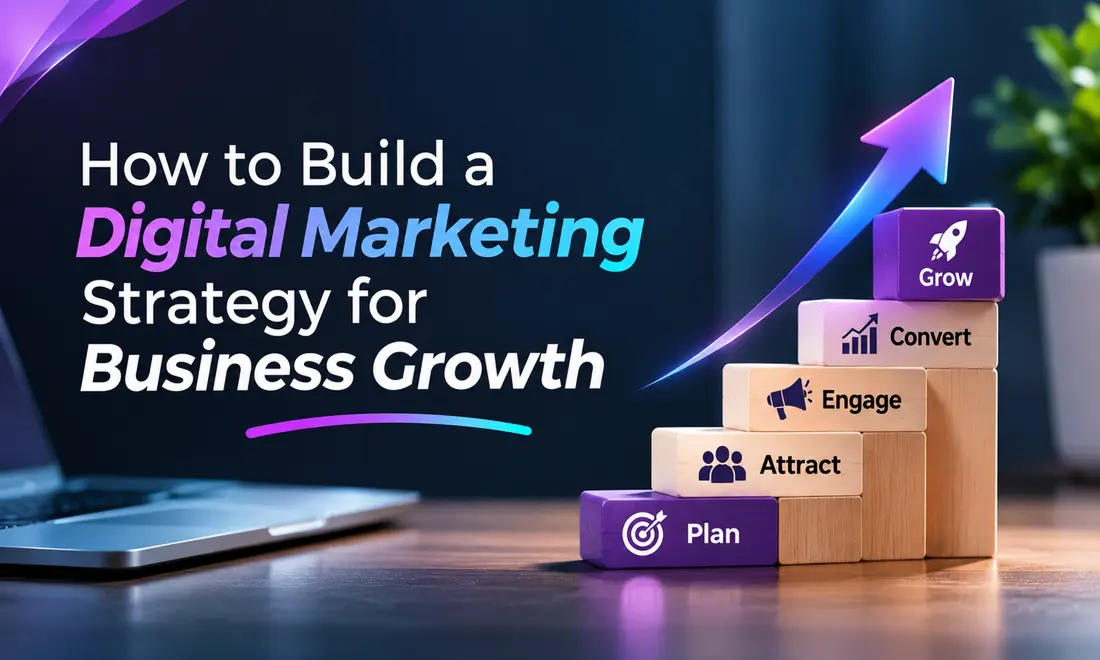
A lot of businesses are visible online but still do not have a clear idea of how that visibility is contributing to revenue. They may be getting website traffic, publishing content, posting on social media and even ranking for useful keywords, yet enquiries remain inconsistent. In many cases, the problem is not the amount of marketing being done. The problem is that each activity is working on its own.
SEO might be bringing people to the website, but those visitors are not reaching the right service pages. Social media may be creating engagement, but there is no clear path from that engagement to an enquiry. The website may look professional, but it does not explain the offer well enough for someone to take the next step. This is where a proper digital marketing strategy for business becomes important. It should connect visibility, content, website experience and sales instead of treating them as separate tasks.
The first thing a business should do is stop thinking about channels and start thinking about outcomes. It is easy to say that the business needs more SEO, more social media or more content, but those are activities, not goals. A better starting point is to decide what the business actually wants marketing to produce. That could be more qualified leads, more bookings, more ecommerce sales or a lower cost of acquiring customers.
Once that goal is clear, the strategy becomes easier to build. For example, if the target is to generate more qualified enquiries, you can look at how people currently find the business, what pages they visit before contacting you and where most visitors leave the website. This makes the digital marketing strategy plan more practical because every activity has a reason behind it.
Understand How Customers Move From Awareness to Action
Customers rarely discover a business and immediately become a buyer. Most people go through several stages before they are ready to contact a company. They may first search for information, then compare different options, check social media, read a case study and return to the website later.
A customer looking for marketing services, for example, might first search for a problem such as why their website is not generating leads. After reading a few articles, they may start looking for SEO or website development services. Before contacting an agency, they may check its LinkedIn page, portfolio and previous work.
This means every part of your marketing has a different job. A blog article may introduce the business. A social media post may build familiarity. A case study may create confidence. A service page may help the customer understand what is being offered. The contact page or WhatsApp button then gives them a way to take action.
A simple journey can look like this:
Search → Content → Service Page → Proof → Enquiry → Sales Conversation
The key is to make sure the visitor can naturally move from one stage to the next.
Use SEO to Attract the Right Visitors
SEO should not only be about increasing traffic. The quality and intent of the traffic matter much more.
Someone searching for “what is local SEO” is probably trying to understand the subject. Someone searching for “local SEO agency for small business” is much closer to buying a service. Both searches may be useful, but they need different types of content.
Informational searches should usually lead to helpful articles that properly answer the question. Commercial searches should lead to pages that explain the service, process, experience and next step. A good SEO strategy should therefore consider intent, not just search volume.
This also helps prevent a common mistake where every keyword is pushed towards a sales page. That approach can make the website feel aggressive and can also create poor search intent matching. Good SEO gives people the information they need at the stage they are currently in.
Content Should Answer Real Business Questions
Many company blogs fail because topics are chosen only because they have keywords. The result is a blog full of articles that may generate impressions but do not support the customer journey.
A better approach is to create content around real questions potential customers are likely to ask. Some people are trying to understand a problem. Others already understand the problem and want to compare solutions. Some are almost ready to buy and simply need evidence that your company is a suitable choice.
Your content can cover areas such as:
- Problems your customers commonly face
- Different ways those problems can be solved
- Comparisons between available options
- Case studies, processes and service-specific information
You do not need to force a sales pitch into every article. An informational blog should primarily help the reader. The commercial value comes from giving them a sensible next step when they are ready.
For example, an article about improving website conversions can naturally link to a relevant website development service. An SEO guide can lead to a more detailed SEO service page. That kind of internal linking feels useful because it continues the reader’s journey rather than interrupting it.
Social Media Works Best When It Supports Trust
Social media is often judged only by direct leads, but that can give an incomplete picture. For many service businesses, people use social media to validate a company before contacting it.
A potential customer may find your business through Google and then check LinkedIn or Instagram to see whether the company looks active and credible. They may look at project work, client results, team activity or educational content.
This is why social media marketing should support the wider marketing strategy rather than operate as an isolated posting schedule. Useful social content can show how the business thinks, how it solves problems and what kind of work it has already done.
Social media does not always need to create the first touchpoint or the final sale. Sometimes its role is simply to make the customer more comfortable with choosing your business.
Your Website Should Help People Make a Decision
When marketing brings visitors to a website, the website has to continue the conversation.
If someone searches for a specific service and lands on a generic homepage, they have to do extra work to find the information they need. Every extra step creates a chance for that person to leave.
This is why important campaigns and search terms should lead to relevant pages. Someone looking for website development should reach a page that clearly explains website development, not a broad page that briefly mentions ten different services.
A strong website development approach should therefore be closely connected with the marketing strategy. The website should not just look professional. It should make the service easier to understand and the next step easy to take.
When a website receives traffic but very few enquiries, look at the experience before investing in more visitors. Ask whether the page clearly explains what is being offered, who it is for and why someone should trust the company.
Some of the most common problems are simple:
- Weak or generic headlines
- Poor mobile experience
- Unclear calls to action
- Too little proof
- Long or confusing forms
- Service pages that sound like every competitor
Fixing these issues can sometimes create a bigger improvement than simply increasing traffic.
Trust Is What Moves People Closer to Buying
Customers are used to seeing businesses describe themselves as professional, experienced or results-driven. Those claims do not carry much weight on their own.
People are more likely to trust proof.
That proof can come from case studies, testimonials, project examples, certifications or a transparent explanation of how the work is delivered. A good case study is especially valuable because it shows how the company handled a real problem rather than simply making a marketing claim.
Instead of saying that a campaign was successful, explain what the original problem was, what was changed and what happened after those changes.
That kind of detail feels more believable and helps a potential customer understand whether the business has relevant experience.
Measure What Happens After the Traffic Arrives
A marketing report can look positive while the business is still not getting results.
Traffic may be increasing. Rankings may be improving. Social reach may be going up. None of those numbers are meaningless, but they need context.
The important question is what happens after the visibility is created.
If traffic increases but enquiries stay the same, there may be a mismatch between the audience and the content. If visitors are reading content but rarely reaching service pages, the internal journey may be weak. If people are visiting commercial pages but not contacting the business, the problem may be trust, positioning or conversion.
This is why digital marketing strategy success should not be judged from one metric.
A business should look at the full path from visibility to revenue.
| Area | Useful question |
| Visibility | Are the right people finding us? |
| Engagement | Are they consuming the content? |
| Intent | Are they moving towards service or product pages? |
| Conversion | Are they contacting or buying? |
| Sales | Are those leads becoming customers? |
This type of measurement makes it easier to understand where the real problem is.
Marketing and Sales Need to Work Together
Generating a lead is not the end of the process.
Once someone makes contact, the digital sales strategy becomes just as important as the marketing that generated the lead.
A business may be producing good enquiries but still losing opportunities because responses are slow, follow-up is inconsistent or the sales process is unclear. In that situation, generating more leads will not automatically produce better results.
If 40 qualified enquiries come in every month and only a few become customers, it may be more valuable to improve how those leads are handled before spending more money on acquisition.
Marketing should therefore help the business understand not only where leads come from, but also which sources produce customers.
That connection between marketing and sales is what turns activity into something commercially useful.
A Good Strategy Is Something You Keep Improving
A digital marketing strategy plan should not be written once and then forgotten.
The first version of a strategy is based on assumptions, research and existing data. Once campaigns begin running, the business starts learning what actually works.
You may discover that one service attracts better leads than another. A particular article may bring visitors who later convert. A social platform may create very little direct traffic but support branded searches. A landing page may need stronger proof before it converts well.
The strategy should change when the data gives you a good reason to change it.
The process does not need to be complicated. Review what is working, find the biggest weakness, improve it and measure again.
That is more useful than constantly adding new channels.
When an Agency Becomes Useful
Not every business needs a digital marketing agency. Some companies already have strong internal teams and enough expertise to manage search, content, development and social media.
An agency becomes useful when different parts of the marketing are disconnected or when the internal team does not have the resources to execute everything properly.
For example, a company may have an SEO person bringing in traffic but no developer improving landing pages. Another may have a strong website but no consistent content strategy. Some businesses have several freelancers working on different areas without one clear strategy connecting the work.
In those situations, the value is not simply having more people working on marketing. The value comes from having the different parts work together.
DIGIFLAI supports businesses through areas such as SEO, website development and social media marketing. The right starting point depends on where the biggest gap exists in the current customer journey.
Build the System Before You Add More Marketing
When results slow down, businesses often respond by doing more.
More blogs, more posts, more ads and more keywords.
Sometimes that is the right answer.
But before increasing activity, look at the system that already exists.
Are the right people finding the business? Are they reaching the right pages? Do they understand the offer? Is there enough proof? Is the next step clear? Are leads being followed up properly?
A useful digital marketing strategy for business connects all of those areas.
When SEO, content, social media, website experience and sales work together, it becomes much easier to understand what is helping the business grow and what needs attention next.
That is far more valuable than simply being visible online.
Frequently Asked Questions
What is a digital marketing strategy for business?
A digital marketing strategy for business is a structured approach to using online channels such as search, content, social media and websites to support business goals. It should also explain how those channels help move potential customers from awareness to enquiry or purchase.
How do you create a digital marketing strategy plan?
Start with the business objective, identify the target customer and understand how that customer makes a decision. Then choose the channels, content and pages needed at each stage and decide how success will be measured.
What makes a digital marketing strategy successful?
A successful strategy should contribute to useful business outcomes. Traffic and rankings are important, but qualified leads, conversion rates and sales provide a better picture of whether the strategy is working.
What is a digital sales strategy?
A digital sales strategy focuses on what happens after a prospect shows buying intent. It can include lead qualification, follow-up, CRM processes, consultations, proposals and other activities that help turn enquiries into customers.
How does digital marketing help increase revenue?
Digital marketing helps businesses attract relevant audiences, educate them, build trust and create clear paths towards enquiry or purchase. Revenue growth depends on how well the entire journey works, not only on the amount of traffic generated.
Should SEO, social media and website development work together?
Yes. They can be managed by different specialists, but they should support the same customer journey. SEO can create visibility, social media can build trust and the website can convert that interest into action.